
Fixstars Amplify releases Amplify AE 1.3, boosting GPU-annealing solver for complex constraints
Fixstars Amplify has released version 1.3 of its combinatorial optimizationcombinatorial optimizationCombinatorial Optimization / Combinatorial OptimizationAn optimization problem that seeks, from many possible combinations of choices, the combination that satisfies given constraints while optimizing the objective value.QI NoteA representative candidate application of quantum computing, but classical algorithms are also very powerful. When evaluating quantum methods, comparisons under equivalent conditions are important. solver, Fixstars Amplify Annealing Engine (Amplify AE), which uses quantum-inspired technologyquantum-inspired technologyQuantum-Inspired Technology / Quantum-Inspired Computing / Quantum-Inspired Technology / Quantum-Inspired ComputingA computing technology that, inspired by concepts and mathematical methods from quantum computing, primarily runs on classical computers. It is widely used especially in the field of combinatorial optimization.QI NoteEven though "quantum" appears in the name, it does not necessarily use quantum hardware. In announcements or publications, verify the actual computing platform and whether an advantage over classical methods has been demonstrated. In particular in the optimization field, there are solvers that already demonstrate practically useful, high-level performance. (GPU annealing). The company says it has introduced a new algorithm that improves solving performance for problems that include complex constraints.
✍️ Quantum Index Analysis
The technical and commercial significance behind the announcement and evaluation points that are not obvious from numbers or headlines alone. Read our analysis ↓
Announcement summary
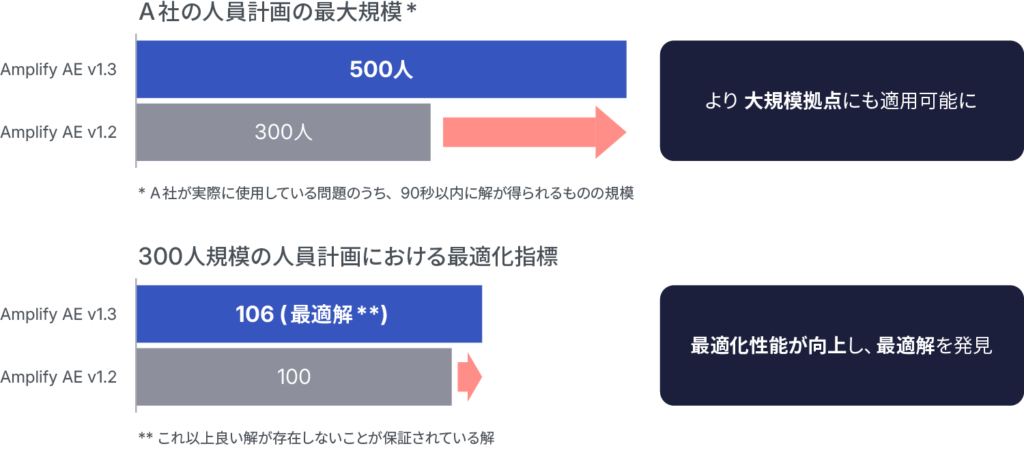
Amplify AE is a solver that uses GPU-based simulated annealing to solve combinatorial optimization problems. In version 1.3, a new algorithm has been adopted to enhance its ability to handle optimization tasks involving multiple constraints, such as workforce scheduling and production planning. In a case study from Company A (see figure below), it reportedly became possible to generate larger workforce plans in a shorter time than before. The announcement did not disclose details of the new algorithm.
Key points
- Released version 1.3 of Amplify AE, a combinatorial optimization solver that leverages GPU annealing
- The new algorithm improves solving performance for problems with complex constraints
- Targeted applications include real-world optimization tasks such as workforce scheduling and production planning
- In Company A’s case study, larger workforce plans could reportedly be generated in a shorter time than before
Technical and business implications
Improved performance in handling complex constraints could expand the range of real-world workforce scheduling and production-planning problems to which Amplify AE can be applied. From a business perspective, the ability to produce larger plans in less time could lead to greater efficiency in planning operations. However, the announcement alone does not allow assessment of the magnitude of the improvements, the comparison conditions, or which types of problems will benefit most.
What to watch next
Going forward, attention will focus on comparisons of computation time and solution quality with previous versions, and on whether the announcement specifies the constraint types and problem sizes for which the new algorithm is effective. In addition to the scale and operational conditions of Company A’s case, the emergence of more deployment examples in production planning and other areas beyond workforce scheduling will be important evidence of practical utility.
✍️ Quantum Index Analysis
The key point of this announcement is not merely an increase in speed for a quantum-inspiredquantum-inspiredQuantum-Inspired Technology / Quantum-Inspired Computing / Quantum-Inspired Technology / Quantum-Inspired ComputingA computing technology that, inspired by concepts and mathematical methods from quantum computing, primarily runs on classical computers. It is widely used especially in the field of combinatorial optimization.QI NoteEven though "quantum" appears in the name, it does not necessarily use quantum hardware. In announcements or publications, verify the actual computing platform and whether an advantage over classical methods has been demonstrated. In particular in the optimization field, there are solvers that already demonstrate practically useful, high-level performance. optimizer, but the enhanced ability to handle the “complex constraints” that are unavoidable in real-world operations. In workforce scheduling and production planning, the ability to accommodate numerous constraints—such as work rules and process ordering—determines practical applicability, so improvements in this area could widen the range of problems suitable for Amplify AE.
On the other hand, the release materials do not clarify the mechanism of the new algorithm or the extent of improvements in computation time and solution quality compared with the previous version. Although Company A’s case shows improved solving performance, it is not possible from this announcement to determine which constraint types or problem sizes can expect similar gains.
Note that the updated Amplify AE is a GPU-based quantum-inspired solver, but the Amplify SDK is not limited to quantum-inspired backends. In addition to Amplify AE, the Amplify SDK supports other vendors’ quantum-inspired solvers, various quantum annealers, gate-model quantum computers, and their emulators, so AE’s performance improvements should be viewed as strengthening one option among several. Going forward, clarifying the problem characteristics for which the new algorithm is effective, and understanding how different backends are used across actual business problems, will be important evaluation points.
Related articles
- NTT Docomo deploys its second production network-optimization app using D-Wave
- Fixstars Amplify SDK adds support for Fujitsu’s superconducting quantum computer “System F”
- IBM expands quantum optimization benchmark QOBLIB, aggregating results for over 2,000 cases