IonQ demonstrates quantum-memory interconnect, exceeding 1 kHz remote entanglement generation
Achieved entanglement generation rates exceeding 1 kHz between trapped-ion qubits and silicon-vacancy (SiV) quantum memory via a photonic interconnect.


Achieved entanglement generation rates exceeding 1 kHz between trapped-ion qubits and silicon-vacancy (SiV) quantum memory via a photonic interconnect.

Updated Factorization Machine internals and sped up surrogate‑model search, slimming the library and shortening processing time.

NTT DOCOMO BUSINESS will propose and sell Classiq’s quantum software development platform and jointly support Japanese companies from use‑case discovery through development and validation.

Pasqal added an AI-assisted feature to Pasqal Cloud that connects formalizing scientific ideas, execution on neutral-atom QPUs, and result processing.

A neutral-atom approach to utility-scale quantum computing will undergo independent verification by DARPA.
IonQ has advanced to Stage C of DARPA’s Quantum Benchmarking Initiative. Multiple generations of Superion will undergo independent evaluation through 2029.

Diraq has been selected for Stage C of DARPA’s Quantum Benchmarking Initiative. An independent team will evaluate the performance, manufacturability, and cost of its silicon spin qubit approach.

QUDORA Japan has been selected for a NEDO project to develop common packaging technology and design rules for cryogenic quantum computers. It will collaborate with Kyocera and AIST (G-QuAT).
IBM introduced a mechanism to call Qiskit’s Rust core directly via the C API, enabling integration of quantum processing into existing HPC and scientific computing code.
Twenty‑eight partners across 11 European countries will build an industrial manufacturing base for lasers, atom chips and other neutral‑atom quantum technologies.

Infleqtion, Honeywell Aerospace, and the University of California, Santa Barbara (UCSB) have prototyped an integrated optical cavity on silicon nitride chips for laser stabilization in quantum devices.

Xanadu and GlobalFoundries have entered a multi-year partnership to industrialize SNSPDs and ultra-low-loss SiN photonics.

FAU received a $200,000 cooperative agreement from NIST to build a hands-on workforce development program with D‑Wave covering quantum computing and critical infrastructure.
Quantum processor company QuantWare has appointed Bart Filius, who has experience with IPOs and major partnerships, as CFO and director.
IBM Quantum announced a new execution model, directed execution. The new primitive, Executor, lets clients inspect and modify error mitigation and circuit randomization from the client side.

Quantinuum and the University of Western Australia have signed an MOU on developing quantum talent and industry use cases. They plan to provide cloud access to quantum infrastructure, including Helios.
D-Wave and the University of Arkansas research center have established a research and education initiative targeting supply-chain challenges in retail, transportation, and defense.
IonQ has acquired Nexus Photonics, a heterogeneously integrated photonics company, gaining a technology base aimed at miniaturizing quantum systems and enabling volume production.
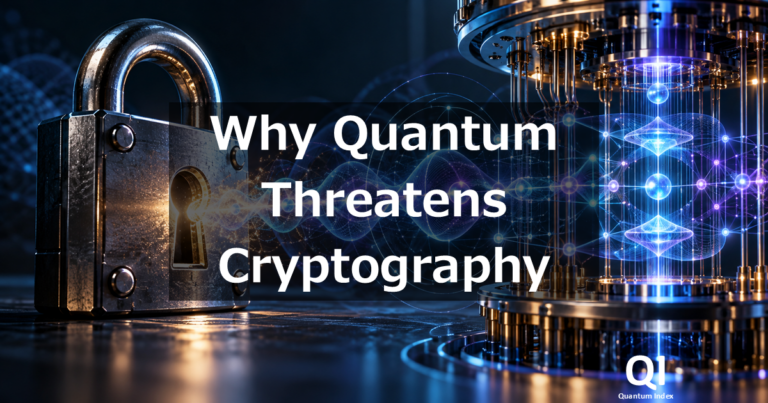
The day encryption is broken lies in the future. Yet the data that will be read then may already be being stolen today. Using RSA and Shor’s algorithm as entry points, this article explains why quantum computers threaten cryptography and why the world has already started migrating to post-quantum cryptography (PQC).
Pasqal has appointed Florence Lao, who has about 20 years’ experience in international legal affairs, as chief legal officer to strengthen governance and legal functions as a public company.

QIA will undertake 42 months of R&D aiming to connect city‑scale networks via quantum repeaters. Qblox will be responsible for the control systems.
D-Wave has launched a beta program for a gate-model quantum simulator based on dual-rail superconducting technology. Four organizations will develop applications with an eye toward future hardware.
Classiq has announced its Fault Tolerance Engine, which plans qubit placement and routing and estimates the physical resources required for fault-tolerant quantum computing.

Alice & Bob and ENS Lyon demonstrated a method to control two-photon dissipation in superconducting cat qubits using a tiny DC voltage instead of microwave drives.
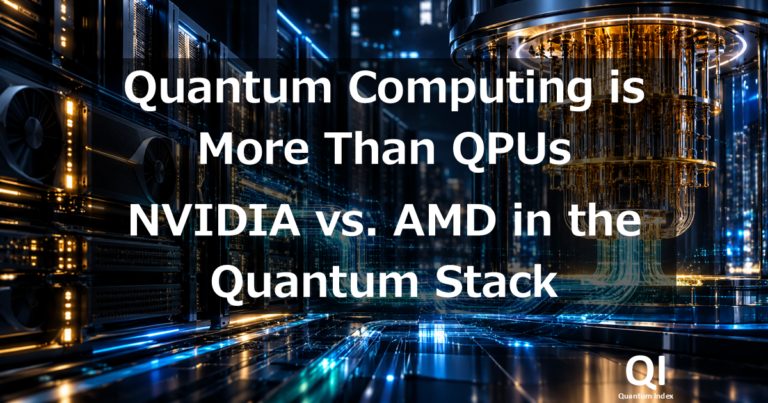
Competition in quantum computing won’t be decided by QPU performance alone. As QEC, real‑time control, and hybrid computation increase the need for low‑latency feedback between QPUs and classical systems, NVIDIA is expanding an integrated stack around CUDA‑Q and NVQLink, while AMD and Xanadu counter with the open heterogeneous platform Backline. Will QPU vendors or platform companies that bind QPUs together lead the quantum computing infrastructure?

IQM has established a performance-linked equity incentive plan through 2032 and a new RSU program to support employee retention and hiring.

A method that approximates a quantum state as a combination of basis functions and reconstructs it with fewer measurements than conventional methods was demonstrated in numerical simulations.
They have developed a compact module to cool single-photon detectors to about 2 kelvin, aiming to reduce reliance on large cryogenic plants through a multi‑million‑dollar partnership.
Diraq will establish an R&D lab at a shared facility in Albuquerque to strengthen testing and characterization of silicon quantum devices.
Infleqtion and Riverlane have signed a memorandum of understanding to evaluate integrating real-time quantum error correction with Infleqtion’s neutral-atom quantum computing platform.